
You publish at 8 a.m. Eastern because a timing guide told you that is when inboxes open. So did everyone else. Your post lands in a three-hour block carrying more than 315,000 other posts, and the readers you wrote it for are sitting in a standup meeting with the notification already buried.
The best time to post on Substack is 21:00 to 23:00 UTC, which is 5 to 7 p.m. US Eastern, with a weekend bias toward Saturday and Sunday. That is not a guess or a survey. We measured 1,370,595 posts from roughly 62,000 publications, published between July 2025 and July 2026, and grouped them by the day and hour they went live. The most crowded publishing window in the data is mediocre. The best one is nearly empty.
Here is the full breakdown by day and by hour, why Notes and long-form posts run on different clocks, and how to find your own window once the global average has done its job.
One number worth having before you start: WriteStack has close to 100 verified reviews from Substack writers across multiple platforms. The other tools in this category have none that we could find anywhere. If you are going to trust someone's read of 1.37 million posts, it is fair to ask who else has vouched for them.
Table of Contents
- What 1.37 Million Posts Say About Timing
- The Best Days to Post on Substack
- The Best Hours to Post on Substack
- The Crowded Window Problem
- Posts and Notes Run on Different Clocks
- Why the Median Tells a Different Story
- How to Find Your Best Time to Post on Substack
- Common Timing Questions
- Hitting the Window Without Living in the App
What 1.37 Million Posts Say About Timing
We pulled every post in our Substack dataset published between July 2025 and July 2026, kept the ones with more than 100 words and public reaction data, and grouped them by the day and hour they went live. That left 1,370,595 posts from roughly 62,000 publications, enough volume that single viral outliers cannot bend the hourly averages on their own.
For each time slot we tracked two numbers. Average reactions per post tells you how posts published in that slot performed. Post volume tells you how many other writers hit publish at the same moment, which matters because your post starts competing for feed positions and inbox attention the second it goes out.
The short answer
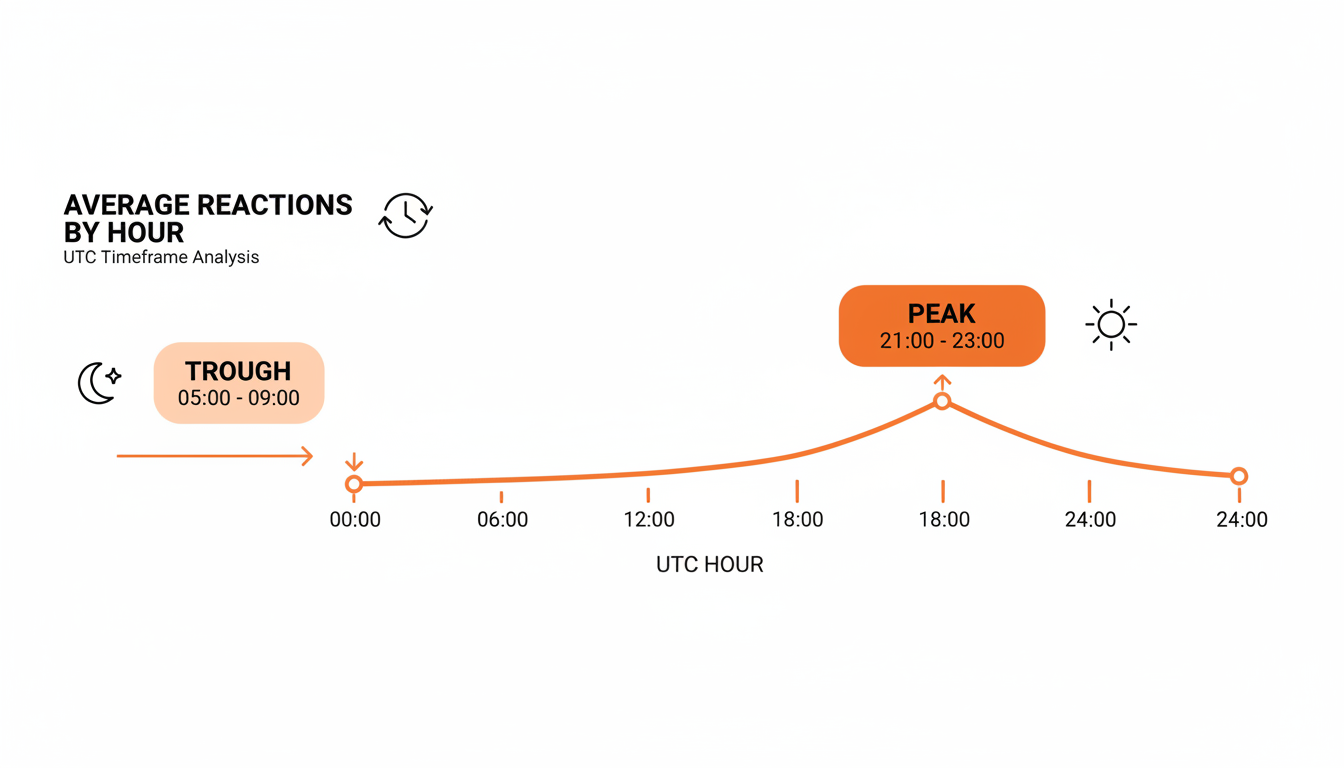
Posts published between 21:00 and 23:00 UTC, which is 5 to 7 p.m. US Eastern time, averaged 29 to 33.9 reactions. Posts published between 05:00 and 09:00 UTC averaged 17.9 to 20.2. The single best hour we measured, 22:00 UTC, beat the weakest hour, 06:00 UTC, by 89 percent.
Days follow a softer version of the same pattern. Saturday posts averaged 26.0 reactions and Sunday posts 25.6, against 23.0 on Friday, the weakest day. The weekend edge over Friday works out to roughly 13 percent.
Put those two together and the recommendation is one line: Saturday or Sunday, 21:00 to 23:00 UTC. Start there, then earn the right to override it with your own numbers.
How to read these numbers
Averages on engagement data get pulled around by breakout posts, so we checked the medians too, and they tell a humbling story. The median post earned 6 reactions in almost every slot, whether it went out on a Tuesday morning or a Saturday evening. Timing barely moved the typical outcome. What it moved was the size and frequency of the wins above the typical outcome.
That distinction shapes how you use this data. Publishing at 22:00 UTC raises the ceiling on a post people want to read, because the readers who react, comment, and restack in the first hours are actually online when it lands, and those early signals decide how far the feed carries it. Same post, better launch window, more distribution.
Practical rule: timing raises the ceiling on a good post. Write the post first, then give it the best launch window you can.
The catch that nobody plans for is logistical. A 22:00 UTC publish time is 6 p.m. on the US East Coast, midnight in Berlin, and 8 a.m. the next morning in Sydney. Two of those three are times you will not be at a keyboard, which turns a timing decision into a queue problem. Start a free 7-day trial of WriteStack and put your next four publishes in the window while the number is still in front of you.
The Best Days to Post on Substack
Here is the full day-of-week breakdown from the same 1.37 million posts:
| Day | Posts published | Average reactions |
|---|---|---|
| Saturday | 129,999 | 26.0 |
| Sunday | 179,084 | 25.6 |
| Tuesday | 212,494 | 24.2 |
| Thursday | 203,455 | 24.1 |
| Wednesday | 208,820 | 23.7 |
| Monday | 215,181 | 23.5 |
| Friday | 221,562 | 23.0 |
Two things stand out. Saturday is the least popular publishing day by a wide margin, with about 41 percent fewer posts than Friday. It is also the best performing day. Friday, the busiest publishing day of the week, performs worst.
Why weekends punch above their weight
Substack reading skews toward leisure. Most readers subscribe to newsletters they read for pleasure, and pleasure reading happens on couches and weekend mornings, when there is time to finish a 2,000-word essay instead of skimming the first paragraph between meetings. Substack's own team makes the same point in its guidance on publishing schedules: if people read you for fun, weekend and evening publishing catches them when they actually have time to read. The corpus data confirms it at scale.
There is a supply effect working alongside the demand effect. With about 130,000 posts going out on a Saturday against 221,562 on a Friday, each Saturday post competes with roughly 40 percent fewer rivals for the same feed slots and the same reading hours.
Practical rule: if your newsletter is read for pleasure rather than for work, move your main post to Saturday or Sunday and measure the difference over a month.
The Best Hours to Post on Substack
Grouped into windows, the hourly data looks like this:
| Window (UTC) | Average reactions | Posts published |
|---|---|---|
| 21:00-23:00 | 29.0-33.9 | 130,093 |
| 17:00-20:00 | 24.7-26.2 | 254,251 |
| 13:00-16:00 | 24.1-26.3 | 398,173 |
| 00:00-04:00 | 20.3-24.5 | 128,241 |
| 10:00-12:00 | 22.0-22.9 | 259,714 |
| 05:00-09:00 | 17.9-20.2 | 200,124 |
The late UTC evening wins clearly. The top three hourly averages in the entire dataset are 22:00 (33.9), 23:00 (30.5), and 21:00 (29.0). The bottom of the table is the 05:00 to 09:00 UTC stretch, which happens to include the European mid-morning and the popular "post before the US wakes up" slot. Whatever logic sits behind that habit, the reaction data does not reward it.
The window in your timezone
The 22:00 UTC peak translates like this during northern-hemisphere summer (shift one hour later in winter):
| Where your readers are | 22:00 UTC in local time |
|---|---|
| US East Coast | 6 p.m. |
| US West Coast | 3 p.m. |
| UK | 11 p.m. |
| Central Europe | midnight |
| Sydney | 8 a.m. next day |
Since Substack's reader base skews heavily American, the simplest reading is that posts landing at the end of the US workday catch the most reactive feed. People close their laptops, pick up their phones, and scroll. Your post arriving at 6 p.m. Eastern meets them there, while a post from 9 a.m. is already twelve inbox positions deep.
The Crowded Window Problem
The most common publishing hour in the dataset is 13:00 UTC, 9 a.m. Eastern, with 108,944 posts. The classic advice to publish before the workday is baked into thousands of queues, and the 12:00 to 14:00 UTC block carries over 315,000 posts, more than any other three-hour stretch.
Those morning posts averaged 22.0 to 25.6 reactions. The 22:00 UTC slot, with 42,823 posts, averaged 33.9. The most crowded window in Substack publishing gets beaten by around 32 percent by a slot that receives two and a half times fewer posts.
What this means for your queue
Standard timing advice creates its own congestion. When every newsletter arrives at 9 a.m. Eastern, every newsletter fights the same crowd for feed placement, and your subject line competes with a dozen others in the same inbox refresh. Evening publishing flips both sides of that equation: fewer competing posts in the feed, and readers who have time to engage rather than triage.
The morning slot still earns its place for some publications. If your readers open you at work because your newsletter helps them do their jobs, keep the morning and skip the rest of this section. For everyone else, the default deserves questioning, and the data gives the off-peak window a measurable edge.
Practical rule: when two windows perform similarly in your own testing, pick the one where fewer writers publish. Less competition for the same readers compounds week after week.
Off-peak windows are off-peak for a reason. The hours where nobody publishes are the hours nobody is awake to publish in, which is exactly why they stay uncrowded and exactly why willpower is the wrong tool for the job. A queue is the right one. WriteStack holds your Notes and chat posts in a calendar view, drops them into the slots you picked once, and publishes them through your own browser session using Substack's native scheduler, so the 3 a.m. slot costs you nothing.
📅 Struggling to stay consistent on Substack?
WriteStack's Smart Scheduling lets you batch and queue Notes in minutes. Grow on Substack without burning out.
Explore Smart SchedulingPosts and Notes Run on Different Clocks
Everything above covers long-form posts, the kind that hit inboxes and the Home feed. Notes behave differently. A Note lives entirely in the feed, has a lifespan measured in hours, and depends almost completely on early engagement to spread.
A separate analysis of 12.4 million Substack Notes found the highest like rates on Notes posted in the early UTC hours, 02:00 to 05:00, with Saturday, Sunday, and Monday as the strongest days. The weekend effect shows up in both datasets. The hours diverge because the formats reach people differently: inbox content gets opened when readers process email, feed content gets scrolled in bed and over breakfast. We broke the Notes clock down hour by hour in a separate piece on the best time to post Substack Notes, which is the one to read if Notes are your main format.
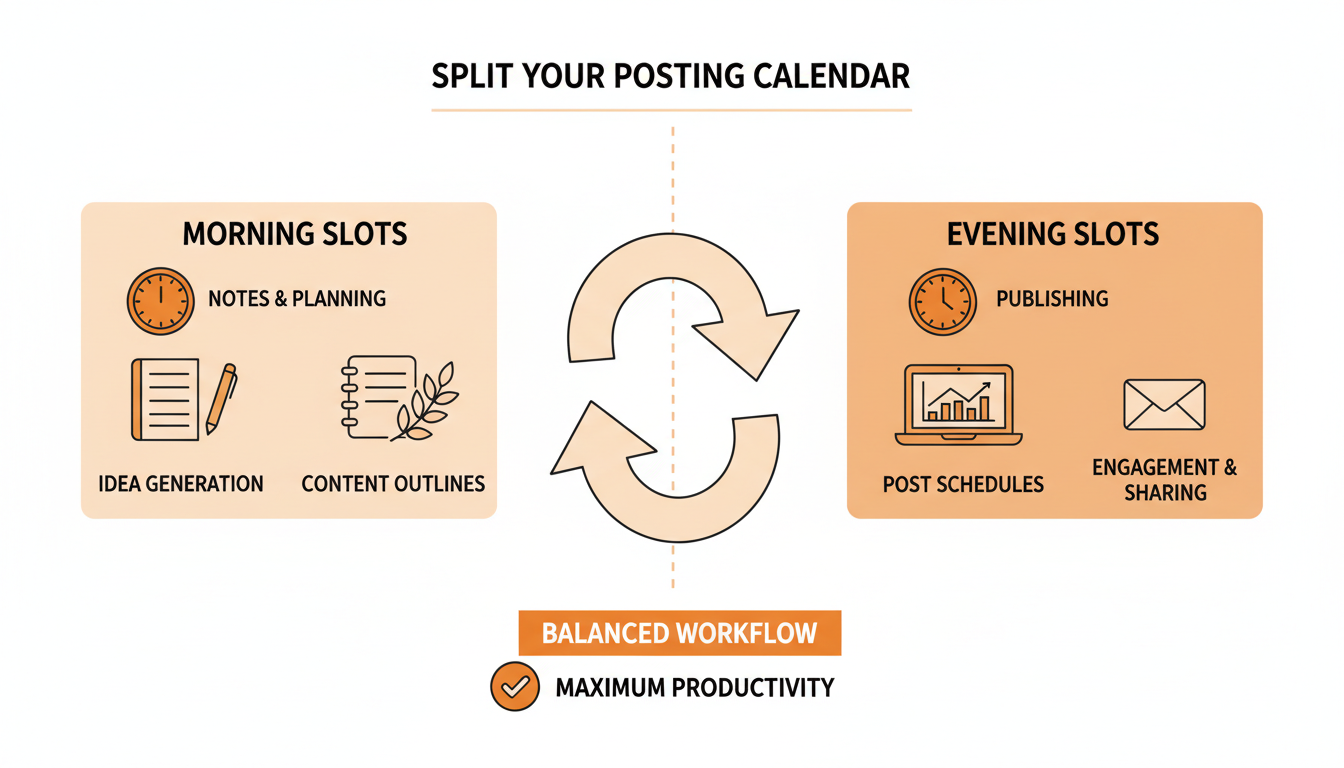
Running both formats well means running two publishing clocks at once, long-form in the 21:00 to 23:00 UTC window and Notes spread across the early-morning windows where they perform. Nobody sets an alarm for 3 a.m. UTC twice a week and keeps it up past the second week. WriteStack's Notes scheduler carries that load instead: write six Notes on a Sunday afternoon, assign them to the early-morning slots, and the schedule runs while you sleep through it.
Start your free trial and load both clocks in one sitting.
Why the Median Tells a Different Story
The flat median deserves its own section because it is the most honest number in this dataset. The typical post earned 6 reactions at 9 a.m. and 6 reactions at 6 p.m. Timing is a multiplier on reach, and a multiplier needs something to multiply.
Substack's data team recommends one post a week as the benchmark tied to growth, and the writers who have scaled the furthest agree on where the real lever sits. Lenny Rachitsky, who grew his newsletter to 500,000 subscribers, lists quality and consistency as the only things that mattered, and puts strategy, design, and titles in the "things that don't matter" pile.
Consistency sets the floor
Treat these as two separate levers. Consistency and quality set your floor, the engagement you can count on every week. Timing moves your ceiling, how far a good post travels when the right readers catch it early. The corpus data prices the timing lever at roughly 30 to 90 percent in average reactions between the best and worst windows, which is a real edge, and it pays out on top of a steady publishing habit rather than instead of one.
The useful part is that a queue fixes both levers with the same action. Batching a month of posts protects the streak that sets your floor, and it is also the only reliable way to land every one of those posts in a window you are asleep for. Consistency and timing stop competing for the same evening.
Practical rule: fix your publishing streak before you fix your publishing hour. A skipped week costs more than a mistimed post.
How to Find Your Best Time to Post on Substack
Saturday and Sunday at 21:00 to 23:00 UTC is the answer until your own data gives you a better one. A newsletter for Australian finance professionals and a newsletter for American fiction readers should not share a schedule. Before locking anything in, answer two questions: where do your readers live, and do they read you for work or for pleasure?
Start with where you have actually been posting
Most writers cannot answer the question "what time do you usually publish" with a number, only with an intention. WriteStack's posting heatmap settles it: every publish you have made, plotted by day and hour, so the gap between the schedule you believe you keep and the one you actually keep shows up as empty squares.
The result is uncomfortable in a consistent way. Writers who describe themselves as "pretty consistent, mostly mornings" find two strong days, a four-day gap, and a catch-up burst on Sunday night. That shape matters for timing because it means your current engagement numbers are not measuring your 9 a.m. slot against your 6 p.m. slot. They are measuring your good weeks against your bad ones, and no timing test survives that much noise. Read the heatmap before you change anything. If it shows real gaps, the first fix is the queue.
The part people don't expect
The hard part of a timing change is not making it, it is proving it worked. WriteStack benchmarks your restack and reaction rates against other publications your size, so "my numbers went up" becomes "my numbers went up more than the field did," which is the only version of that sentence that means anything after a platform-wide good week. It runs trend analysis month over month, so you see direction rather than a snapshot, and a slow slide gets caught while it is still slow. And its link-click history tracks which of the two links inside a Note got clicked, going back to your very first Note, so an evening slot that produces more reactions but fewer clicks to your archive gets exposed instead of celebrated. A per-account dashboard structurally cannot answer any of those, because it can only ever compare you to yourself.
A four-week timing test
To test the evening window against your current slot without guessing:
- Keep your format and topic mix steady for the test month, so timing is the only variable that moves.
- Publish two posts in your current slot, then two in the 21:00 to 23:00 UTC window (or whatever your heatmap and audience geography suggest).
- Compare first-24-hour reactions and opens between the two pairs, then run the cycle once more before you conclude anything, because four posts is a small sample.
- Schedule all eight in advance. A test where you sometimes forget to publish is not a test of timing.
Practical rule: judge a timing test on first-24-hour engagement. That isolates the launch window from long-tail discovery and restacks.
How you will know it worked
Substack's own stats will tell you what happened inside your publication. They cannot tell you what happened outside it, which is where the answer lives.
| What you need to answer after a timing change | Substack's built-in stats | WriteStack |
|---|---|---|
| Is my restack rate good for a publication my size? | No, your own account only | Yes, benchmarked across publications |
| Is engagement climbing or sliding month over month? | Snapshot only | Trend analysis over time |
| Which link inside that Note got the clicks? | No | Yes, per link, back to your first Note |
| When have I actually published, hour by hour? | No | Posting heatmap across your full history |
| Can I queue a month into one window in a single sitting? | One at a time | Batch scheduling with a calendar view |
| Can I put a chat post in the window too? | No | Yes, and no other tool in the category does |
| Verified reviews from Substack writers | Not applicable | ~100 across multiple platforms |
The first row is the one that decides the test. If your reactions rose 20 percent after you moved to Saturday evenings, and every publication your size rose 20 percent that month because of something in the feed, you learned nothing and you are about to lock in a schedule for the wrong reason. Benchmarks against the field turn a coincidence into a result.
Common Timing Questions
Does the best time differ for paid newsletters?
The reaction data above measures public engagement, and paid subscribers behave differently: they paid to read you, so they open on their own schedule regardless of when you publish. For paid posts, a fixed and predictable slot your subscribers learn to expect matters more than chasing the feed's peak hours. Save the timing games for your free, public posts, where feed distribution decides who discovers you.
What if I publish more than once a week?
Spread, don't stack. Two posts in the same window split the same audience's attention, while a weekend post plus a midweek evening post reach two different reading moods. Frequency carries its own tradeoffs beyond timing, and for the Notes side of the schedule we worked through the volume question separately in our guide on how many Substack Notes to post per day.
Does timing affect subscriber growth or just reactions?
Reactions are the measurable proxy, and they sit upstream of growth. Early reactions and restacks push a post further through the feed, and feed reach is where strangers first meet your writing. Our read of the data is that timing affects growth through that chain rather than directly: a well-timed post earns more early signals, the early signals buy more distribution, and distribution puts your subscribe button in front of new readers.
Hitting the Window Without Living in the App
The awkward truth about the 21:00 to 23:00 UTC window: for Europeans it is nearly midnight, and for anyone in Asia or Australia it lands mid-morning at work. The best publishing window is a bad living window. Every writer who has read a timing study and changed nothing hit that wall, and it is a scheduling problem wearing the costume of a discipline problem.
Scheduling closes the gap. Substack handles scheduled long-form posts natively. WriteStack fills the missing half: Notes and chat posts queued a week or a month at a time, dropped into the windows this data points at, published through your own browser session so nothing runs on someone else's server while you sleep.
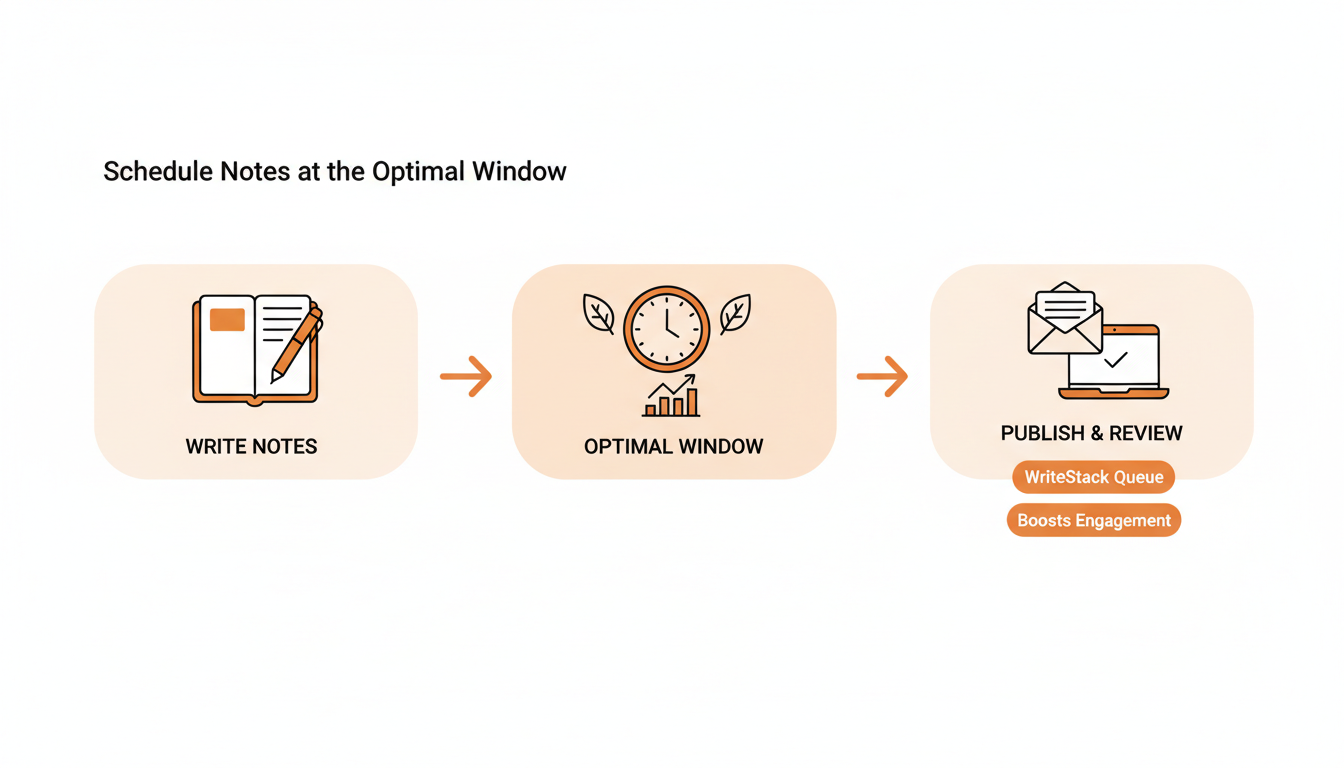
Six weeks into running a queue, the change is not that your posts land at a better hour. It is that the hour stopped being a decision you make on a Saturday night. Your heatmap shows the gaps, the queue closes them, and the benchmarks tell you the new window is beating the field rather than beating last Tuesday.
By the numbers, the best time to post on Substack is 21:00 to 23:00 UTC with a weekend bias, adjusted to wherever your own readers live. Finding your window is analysis. Hitting it fifty-two weeks running is logistics, and close to 100 verified reviews from Substack writers say WriteStack handles that half. No other tool in this category has any reviews we could find anywhere.
Start a free 7-day trial. Queue a month into the 22:00 UTC window tonight, then go to bed while it publishes.