
Eleven subscribers. That was my count three weeks after launching, and four of them shared my last name. If you just started a Substack, your dashboard probably looks similar, and every guide you find repeats the same two ideas: tell your friends and be patient.
Both are fine. Neither is a plan. This guide covers how to get your first 100 Substack subscribers with numbers behind each step, pulled from a dataset of 46,118 Substack publications we analyzed at WriteStack, plus a separate sample of 20,000 recent Notes that says what to actually type into the feed.
The short version: your first 100 subscribers come from two directions. People who already know you, and people who find you inside Substack's own network through Notes and recommendations. The first group runs out around subscriber 30. Everything after that is a Notes problem, which is why most of this guide is about Notes.
One number worth having before you start: WriteStack has close to 100 verified reviews from Substack writers across multiple platforms. The other tools in this category have none that we could find anywhere.
Table of Contents
- Why the First 100 Are the Hardest
- Start With the Audience You Already Have
- Use Substack Notes as Your Discovery Channel
- The Question Your Own Dashboard Cannot Answer
- Turn On Recommendations Early
- Make Your Publication Easy to Subscribe To
- A 90-Day Plan to 100 Subscribers
- Mistakes That Stall You at 30 Subscribers
- What Happens After 100
Why the First 100 Are the Hardest
Substack growth compounds. A restack puts your note in front of someone else's followers, a recommendation sends you subscribers while you sleep, and a good post gets forwarded. At zero subscribers, none of that machinery exists yet. Nobody restacks you, nobody recommends you, and nobody forwards your posts, because nobody has read them.
So the first 100 subscribers are manual. You earn them one conversation, one note, and one small favor at a time, which also means they are almost entirely under your control, something you will never be able to say about subscribers 10,000 through 20,000.
There is also a survivorship problem with most advice here. It comes from writers with big audiences describing what works for them now, with an established name and an archive of 200 posts. What works at 50,000 subscribers tells you very little about what works at 11.
A timeline helps too. For a new publication with no outside audience, 90 days to reach 100 subscribers is an honest target. A writer arriving with an existing Twitter or LinkedIn following can compress that into weeks. If you are starting from zero, plan for the full quarter and treat anything quicker as a bonus.
What the Data Shows About Early Consistency
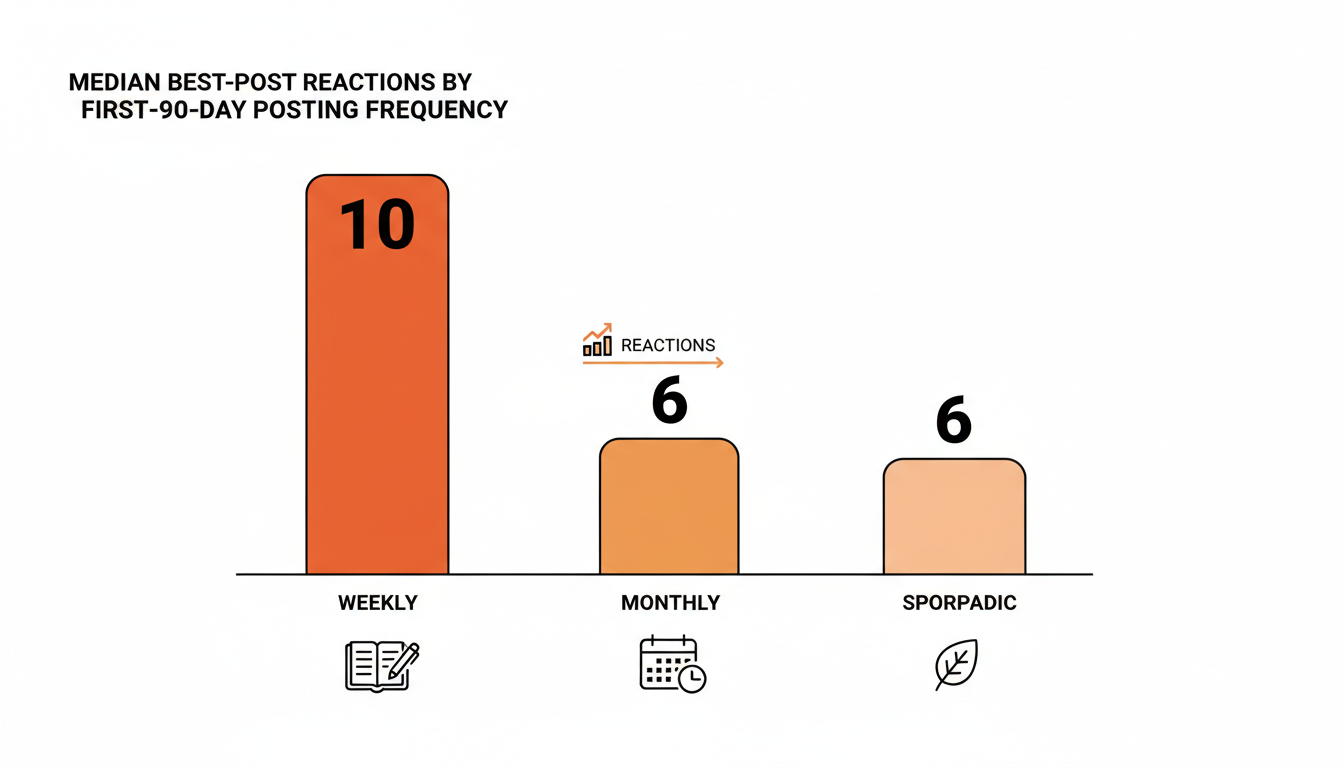
We pulled the posting histories of 46,118 Substack publications and grouped them by how often they published in their first 90 days. Then we measured each publication's best-performing post in months four through six, using public reaction counts.
| Posts in first 90 days | Publications | Median best-post reactions in months 4-6 |
|---|---|---|
| Weekly or more (12+ posts) | 23,229 | 10 |
| One to three per month (4-11 posts) | 17,578 | 6 |
| Sporadic (1-3 posts) | 5,311 | 6 |
Publications that posted at least weekly in their first 90 days had a median best post that earned 67% more reactions in months four through six than publications that started slower. The gap between "monthly" and "sporadic" was zero. Posting occasionally performed no better than barely posting at all.
We used medians rather than averages here on purpose. A small number of already-famous writers who post rarely and still get thousands of reactions skew every average upward, and you are not them yet.
Practical rule: Decide your publishing schedule before you chase a single subscriber. Weekly is the floor that shows up in the data, and it matters more than any individual growth tactic below.
That floor is the whole difficulty. Ninety consecutive days of showing up is a scheduling problem long before it is a writing problem. Start a free 7-day WriteStack trial and put your first two weeks of Notes into the queue before you write a single subscriber ask.
Start With the Audience You Already Have
Substack's own guide to your first 100 signups starts here too, and for good reason. The people who already know you convert at a rate no stranger ever will. For most writers, the existing network is good for the first 20 to 40 subscribers, which is a fifth to a third of the way to 100 before a stranger ever sees your work.
The mistake is doing this passively. Posting "I started a newsletter" once on social media and hoping is not the same as asking.
The Direct Ask That Works
Individual messages beat broadcasts. A text or DM written for one specific person converts several times better than an announcement blasted to everyone.
Keep it short and specific: "I started a newsletter about restoring vintage bikes. You came to mind because of that Peugeot you rebuilt. First post is here if you want it in your inbox." No guilt, no mass BCC, no follow-up if they pass. Twenty messages like that in your first week will typically outperform every social post you make that month.
Put Your Link Where People Already See You
Your Substack URL belongs in your email signature, your social bios, and any profile that gets views: LinkedIn, X, Instagram, GitHub, a personal site. Each spot produces a trickle, and trickles from four or five places add up to a steady drip of subscribers you did nothing extra to earn.
Practical rule: Send 10 individual messages before you make one public announcement. The personal ask is the highest-converting channel you will ever have, and it expires as your launch gets older.
Use Substack Notes as Your Discovery Channel
Notes is Substack's short-form feed, and for a writer with no outside audience it is the one place strangers can find you the same day you join. When someone likes or restacks your note, it appears in front of their followers, and a reader who clicks through can subscribe in two taps.
Your personal network tops out around 30 or 40 subscribers, so the remaining 60 or 70 depend on a daily publishing habit you have never run before. The writers winning on Notes in 2026 treat it as its own format, and the ones stuck at 30 subscribers treat it as a place to drop links.
What to Post on Notes
Short, self-contained observations from your niche work best: a lesson, a strong opinion, a before-and-after, a single surprising number. The note should be worth reading even if nobody clicks anything. Excerpts from your posts work when the excerpt stands alone. Questions work when you actually want the answers.
What fails is the link dump ("new post, link below") with nothing of substance in the note itself. The feed treats it like the ad it is. A useful test: if the link were removed, would anyone still like this note. If the answer is no, rewrite until it is yes, then attach the link.
Blank-page days are the real constraint here, not taste. WriteStack's note generator drafts from Notes and posts you have already published, so the draft starts in your voice instead of arriving at it after three rounds of editing. Every other tool in this category generates from a prompt, which is why their output reads like a stranger doing an impression of you. If a draft misses anyway, you switch models rather than living with one fixed voice.
What 20,000 Notes Say About Shape and Length
Advice about Notes is usually vibes. We pulled a sample of 20,000 recent Notes to replace two of those vibes with numbers.
Multi-line Notes averaged about 11% more reactions and about 28% more restacks than single-line Notes. The restack gap is the one that matters at zero subscribers. A reaction is a nod from someone who already found you, while a restack is the only mechanism that puts your writing in front of an audience you did not have that morning.
Length moved the same direction. Notes running 150 to 300 characters beat Notes under 50 characters by roughly a third on reactions, and by more than that on restacks. The one-line hot take gets scrolled past. Three or four short lines with a break between them get read, then get passed along.
Neither number is a formula, and a weak idea at 200 characters is still a weak idea. Use them as the default shape you write against on the days you have no instinct about it, which at eleven subscribers is most days.
Practical rule: Write Notes in two to four short lines, aim for 150 to 300 characters, and keep the payoff inside the note rather than behind the link.
How Often to Post Notes
Daily, or close to it. A note has a short life in the feed, usually a day or two, so presence matters more than polish. One decent note every day beats a brilliant one every two weeks.
Daily for 90 days is roughly 90 Notes, and almost nobody produces those one at a time at the moment of posting. The writers who hold the streak batch: six or eight Notes in one sitting on a good day, dropped into a queue, so a busy Tuesday costs them nothing. WriteStack was built for that pass, and the Notes go out through Substack's own native scheduler while your session stays in your browser.
📅 Struggling to stay consistent on Substack?
WriteStack's Smart Scheduling lets you batch and queue Notes in minutes. Grow on Substack without burning out.
Explore Smart SchedulingTiming helps at the margin. We covered the numbers in detail in WriteStack's best time to post on Substack article, and WriteStack's heatmap shows when your specific audience is actually online rather than when a generic best-practices chart says they should be.
Practical rule: One note a day for 90 days beats ten notes on launch day. Batch a week of notes in one sitting and schedule them, so a busy Tuesday can't break the streak.
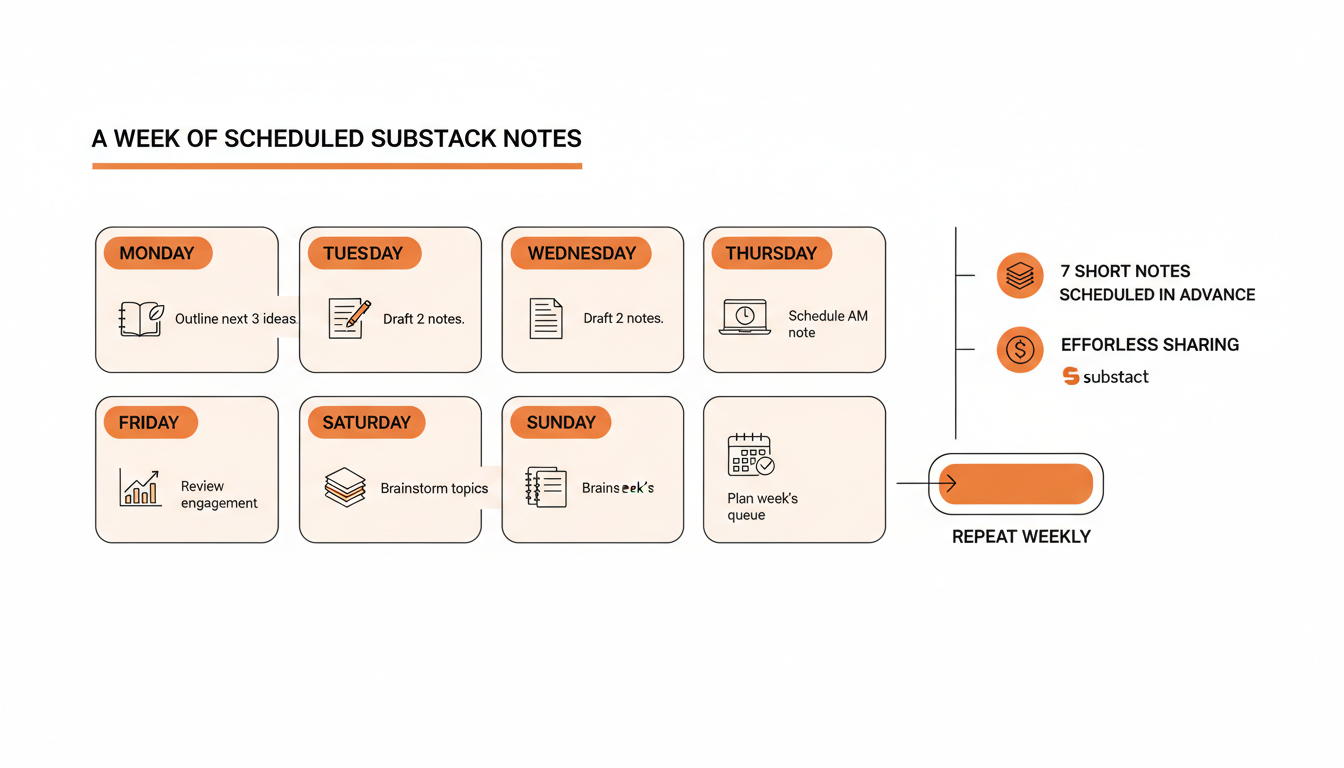
Start your free trial and load a week of Notes in twenty minutes.
The Question Your Own Dashboard Cannot Answer
At 40 subscribers, your own analytics are noise. Three reactions on Tuesday and eleven on Thursday tells you nothing, and you will spend weeks reading tea leaves in it anyway.
Every new writer wants to know one thing: is this normal. Nine reactions on a note, at 40 subscribers, in a niche like mine, is that a good day or a bad one. A per-account dashboard structurally cannot answer that, because it only ever compares you to you, and at this stage "you" is a sample of nine Notes. WriteStack benchmarks your reaction and restack rates against other publications instead, and shows which direction they are moving month over month.
The live inspiration feed does the same job from the other side. Having no data of your own means borrowing the field's, and WriteStack's feed updates continuously from live Notes data, so what you see on a Tuesday reflects what is working on Substack that week rather than what worked whenever a page was last edited. Narrareach's equivalent is a static list, which was accurate on their live page as of July 2026. At 5,000 subscribers that difference is a convenience. At 11 it is the only teacher you have.
| What a writer at 40 subscribers needs | Substack native | WriteStack |
|---|---|---|
| Answer "is this normal for a publication my size" | No | Yes, benchmarked against other publications |
| An inspiration feed reflecting what is working this week | No | Yes, updates continuously from live Notes data |
| Link-click history per link inside each Note | No | Yes, back to your first Note |
| Trend direction month over month | No | Yes |
| Schedule Substack chat posts | No | Yes, and no other tool in the category does |
| AI drafting from your own published Notes | No | Yes, with model selection |
| Queue a week of Notes in one sitting | Manual, one at a time | Built for this |
| Verified reviews from Substack writers | Not applicable | ~100 across multiple platforms |
| Price | Free | From $19.99/month, 7-day free trial |
The part people don't expect
WriteStack benchmarks your restack rate against other publications instead of against your own last week, which is the only version of that number worth reading when your own sample is nine Notes long. It schedules Substack chat posts, which no other tool in this category does at all. And it tracks which of the two links inside a note got clicked, going back to your very first one, so "that one did well" turns into "that one sent 23 people to the archive."
We built WriteStack. We also linked every claim about every competitor here to that competitor's own live page, so you can check all of it yourself.
Turn On Recommendations Early
Recommendations are Substack's built-in referral system: when a writer recommends your publication, their new subscribers see yours as a suggested follow. Substack's network features, with recommendations at the center, drive more than half of all new free subscriptions on the platform, according to this roundup of Substack statistics. No other channel on this list has that kind of weight behind it.
New writers assume recommendations only help people who already have an audience. The opposite move is what works: recommend first. The week you launch, recommend five to ten publications in your niche that you actually read. Their writers get notified, and some will check out your work. Comment on their posts with something worth reading, and a few of those relationships turn into reciprocal recommendations within a couple of months.
That commenting habit is where the browser tabs multiply: ten publications to track, notifications in three places, replies you meant to answer and forgot by Thursday. WriteStack's Activity Center keeps that engagement workflow in one place, which matters when relationship-building is your actual growth channel for the quarter.
Pick your targets deliberately. A publication ten times your size in the same niche is the sweet spot: big enough that a recommendation moves your numbers, small enough that the writer still reads their own notifications. Skip the celebrity accounts, and skip anything outside your topic, because a recommendation from an unrelated publication sends subscribers who never open your emails and drag your open rate down. Two or three incoming recommendations from mid-sized publications can quietly become your single largest subscriber source before you reach 100.
Practical rule: Recommend generously the week you launch. It costs nothing, it notifies every writer you recommend, and reciprocal recommendations are the closest thing Substack has to free distribution.
Make Your Publication Easy to Subscribe To
Every tactic above sends a stranger to your publication page. What they find there decides whether the visit becomes a subscription, and most new publications lose the sale at this step with an empty about page and a default welcome email.
Your About Page and Welcome Email
Your about page has one job: tell a stranger what they get and how often they get it, in the first two sentences. "Weekly teardowns of one indie SaaS business, every Thursday" beats three paragraphs of personal journey. Specificity converts, vagueness bounces.
The welcome email matters more than most writers think, because it lands at peak interest, seconds after someone subscribes. Set expectations, link your two or three best posts, and ask one question that invites a reply. Replies train inboxes to keep you out of spam, and even a 5% reply rate gives you a running list of what your readers want more of, which quietly writes your next month of posts for you.
Your First Ten Posts
Your archive is your sales page. A visitor who liked one note will scroll your post list before subscribing, and ten posts on one coherent topic close that sale far better than three posts across three unrelated topics.
Depth beats breadth here. The first ten posts should make one kind of reader think "this is exactly my thing," rather than making five kinds of reader think "maybe."
Practical rule: Write your about page for the stranger who just read one note, liked it, and is giving you 15 seconds to explain why you deserve their email address.
A 90-Day Plan to 100 Subscribers
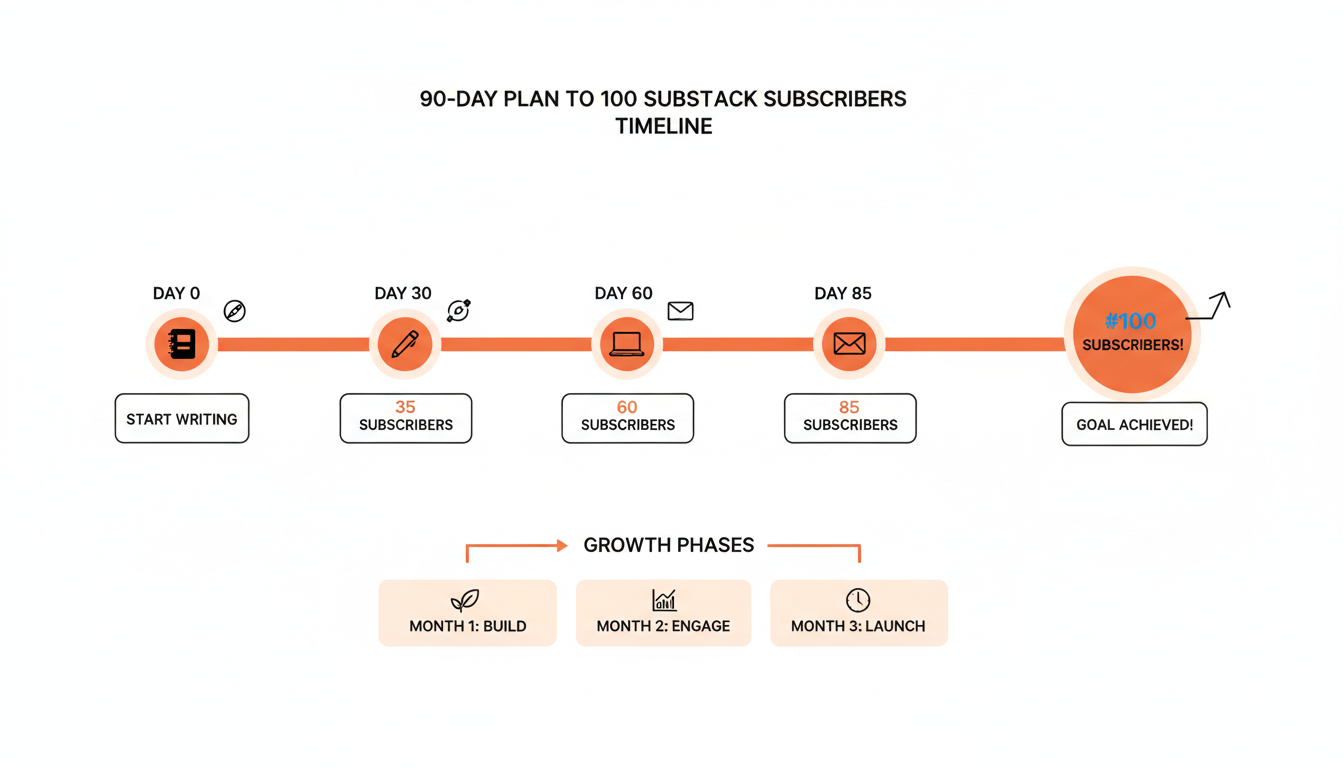
Here is the whole guide as a schedule. The targets assume a defined niche and the weekly-or-better publishing rhythm the data supports. They are checkpoints rather than guarantees, and being two weeks behind means nothing as long as the line still points up.
| Weeks | Focus | Subscriber checkpoint |
|---|---|---|
| 1-2 | Set up the about page and welcome email, publish two posts, send 15-20 individual asks, add your link to every bio | 20-35 |
| 3-6 | Publish weekly, post one note a day, recommend 5-10 publications, comment on posts in your niche | 40-60 |
| 7-10 | Keep the streak, repost your best-performing note topics in new forms, follow up on recommendation relationships | 60-85 |
| 11-13 | Publish a bigger swing post (guide, teardown, or data piece), excerpt it heavily on Notes | 100 |
The pattern worth noticing: the personal-network phase front-loads the count, and the Notes-plus-recommendations phase does the compounding. Writers who skip phase one start slower, and writers who skip phase two stall at whatever their network was worth.
Read the middle column again and count the daily obligations. One note a day for 13 weeks, a weekly post, ongoing comments, plus tracking which of it worked. Doing that by memory is why most 90-day plans die in week five. WriteStack's pricing starts at $19.99/month, with cross-posting through Buffer to 11 platforms on the tier above and a 7-day free trial on all of them. There is no free-forever tier, because the analytics layer is the product and it cannot be sampled meaningfully at 30 Notes a month.
Practical rule: Track subscribers weekly, not daily. Daily counts swing on noise and will talk you out of a plan that is working.
Mistakes That Stall You at 30 Subscribers
Most stalled Substacks fail the same few ways, and none of the failures are about writing quality.
- Publishing into the void. Writing weekly posts while never touching Notes means your only readers are the subscribers you already have, which at this stage is nearly nobody. Notes is where new eyes come from.
- Treating Notes as a link dump. A feed full of "new post, link below" gets scrolled past. Give the feed something that works on its own.
- Writing one-line Notes. The 20,000-Note sample is clear on this: single-line Notes gave up about 28% of their restacks against multi-line ones, and restacks are your entire discovery mechanism at this size.
- Changing topics every week. A visitor cannot tell what your publication is about, so they don't subscribe. Pick a lane for the first 100 and widen it later.
- Relaunching after a missed week. If you miss a week, do not apologize or start over. Post the next thing on schedule. Nobody noticed the gap except you.
- Quitting at week six. Week six is where the personal network is exhausted and compounding hasn't kicked in yet. The publications in our dataset that broke through are overwhelmingly the ones still posting in month four.
Practical rule: When growth feels stuck, audit your last 30 days of output before your strategy. In almost every stalled case we see, the schedule broke first and the growth broke second.
What Happens After 100
Somewhere past 100 subscribers, the manual phase ends. Restacks start reaching people you have never interacted with, a recommendation or two sends a steady trickle, and your welcome email does the closing for you. The machinery you built by hand starts running on its own, fed by the same weekly rhythm that got you here.
A room with 100 people who chose to be there is a real audience, and every large Substack you admire passed through exactly this stage.
Ninety days in, the change isn't that you post more. It's that you stopped deciding. Tomorrow's note is already written and already queued, and you know your restack rate is running above typical for a publication your size because something told you so rather than leaving you to guess.
That gap between a plan on a page and 100 subscribers in a dashboard is what WriteStack is for: batched Notes that survive a bad week, drafts that start in your own voice, and benchmarks that place you against the field rather than against a three-week archive. Close to 100 verified reviews from Substack writers back that up, and no other tool in this category has any we could find.
Start your free 7-day trial. Queue your first week of Notes tonight, and start the 90 days tomorrow.