
Most people picking a Substack niche start with a list: AI, wellness, money, personal essays. Then they stare at the list and pick whichever topic sounds least embarrassing to tell their friends about.
That's the wrong starting point. The question worth answering is how to choose a Substack niche you can sustain for a year, one that already has readers looking for it, and one that doesn't fall apart the first week you don't feel like writing.
We pulled a sample of over 440,000 Substack posts to see which topics hold reader attention once you look past the hype, and the results don't match what most "pick your niche" advice assumes. The more useful finding came from what the data can't tell you: nobody knows their niche until they've tested it in public, and Notes are the cheapest test the platform offers.
One number worth having before you start: WriteStack has close to 100 verified reviews from Substack writers across multiple platforms. The other tools that claim to help you find and grow a niche have none that we could find anywhere. That is not a small gap in a category where most products launched in the last eighteen months.
Table of Contents
- What Actually Makes a Substack Niche Work
- What 440,000 Substack Posts Say About Niche and Engagement
- The Three C's: Curious, Crowd, Cash
- Finding the Overlap Between Passion and Demand
- Researching Substacks Already Writing in Your Niche
- Niche of Topic vs. Niche of Perspective
- Testing Your Niche in Public Before You Commit
- Common Niche-Picking Mistakes
What Actually Makes a Substack Niche Work
A Substack niche is a bet about two things at once: what you can write about without running out of ideas by month three, and what a specific group of readers is already hunting for.
Most niche advice treats this as a single decision made once, upfront, based on vibes. In practice it's closer to a hypothesis you test. You pick a starting point narrow enough to write with authority, publish into it for a stretch, and pay attention to what happens: who subscribes, what they share, what they reply to.
The topic itself matters less than most beginners assume. What matters more is whether it gives you a specific reader to write for, a problem worth solving repeatedly, and enough personal interest that post number forty doesn't feel like homework.
Practical rule: if you can't picture the exact person your next post is for, the niche is still too vague. Name a reader, not a category.
Two writers can both technically write about "wellness" and end up with completely different newsletters. One chases whatever health topic is trending that week. The other writes for new parents dealing with sleep deprivation, drawing on a narrow set of problems they can speak to with authority. The second has a smaller addressable topic on paper and a far easier time keeping subscribers, because every post is clearly for someone.
Treating the niche as a hypothesis has one requirement most writers skip: something has to record the test. If your evidence is a vague memory of which posts felt like they did well, you will confirm whatever you already believed in January. WriteStack was built around that gap, holding your published Notes and posts, what each one earned, and how that compares to other publications, so the decision runs on a record instead of a mood.
Start your free 7-day trial and start recording the test from post one.
What 440,000 Substack Posts Say About Niche and Engagement
Most "best Substack niches" lists are guesses dressed up as advice. We wanted an actual number, so we sampled roughly 15% of a corpus of about 3 million Substack posts, close to 440,000 of them, sorted each into a topic bucket by keywords in its title and subtitle, and compared average reactions per post across categories with enough volume to be meaningful. The gap between categories is bigger than most writers expect.
| Niche | Avg. reactions per post | Posts in sample |
|---|---|---|
| Politics | 31.9 | 2,982 |
| Philosophy | 31.6 | 224 |
| True crime | 29.6 | 411 |
| Psychology | 24.5 | 260 |
| Parenting | 23.7 | 2,910 |
| Health/wellness | 22.0 | 5,058 |
| Finance/money | 20.0 | 5,161 |
| AI/tech | 15.4 | 14,022 |
| Business/marketing | 9.1 | 2,582 |
| Crypto | 9.0 | 1,377 |
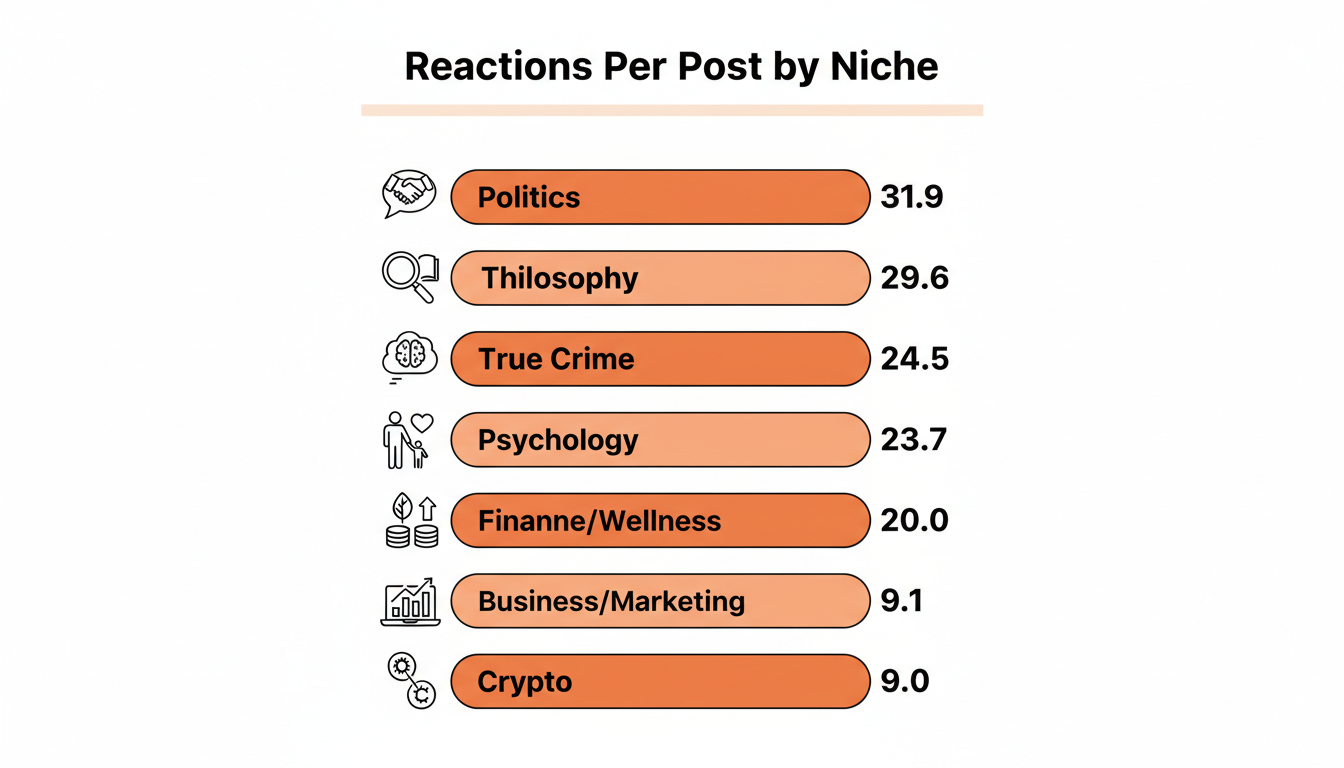
Practical rule: treat this table as a starting filter, not a verdict. A low average doesn't mean a niche is dead, it means the average post in it is competing against a lot of noise. A high average doesn't guarantee you'll perform above it either.
A category average is a useful filter and a terrible scorecard. The number that decides whether you keep going is your own performance measured against writers in your category at your size, a comparison no per-account dashboard can make because the comparison set isn't in the building. That number comes back in the testing section.
The Niches With the Most Writers Aren't the Niches With the Most Engagement
AI/tech had the largest sample of any category we measured, 14,022 posts, more than four times the volume of health/wellness and roughly 60 times the volume of philosophy. It also landed near the bottom of the table for average reactions per post, at 15.4.
That's not a coincidence. Everyone can see AI is hot, so everyone piles in, and a flooded topic means each post competes with far more alternatives for the same reader's attention. Philosophy, true crime, and psychology carry a fraction of the writers and a noticeably higher average reaction count. Fewer writers, less noise, more attention per post published.
This doesn't mean "go write about philosophy instead of AI." It means volume and opportunity aren't the same thing, and a topic being popular to write about is a weak signal for whether it's a good niche for you to enter.
The Three C's: Curious, Crowd, Cash
One of the clearer mental models for this comes from the newsletter Grow Getters, which frames a viable niche as needing three things at once: Curious, Crowd, and Cash. You need to actually be curious enough about the topic to keep writing about it. There needs to be a crowd, an identifiable group of people already gathering around that topic somewhere, whether that's Substack itself, Facebook groups, subreddits, or forums. And there needs to be some connection to cash, either because the topic touches money directly or because the audience already spends on adjacent things.
Miss one and the niche fails in a predictable way. Curious without a crowd produces a beautifully written newsletter nobody finds. Crowd without curiosity produces a newsletter that reads like assigned homework, and readers can tell. Crowd and curiosity without a path to cash works fine if you're not trying to make money from it, so be honest about which you're chasing before you start.
Practical rule: write down one sentence for each of the three C's before you publish post one. If any sentence is hard to write, that's the part of your niche that needs more thought, not less.
Run a candidate topic through this before committing. Say you're considering a newsletter about home coffee roasting. Curious: do you roast coffee weekly, or did you just read one good article about it? Crowd: are there active forums, subreddits, or existing Substacks with real comment activity on this exact topic, not just a general coffee tag? Cash: do people in that crowd already spend on beans, equipment, or classes, since that tells you whether a paid tier later has anywhere to attach itself.
The crowd question is the one people answer worst, because they answer it from memory. Reading four newsletters you already subscribe to tells you what that topic looked like whenever you subscribed. WriteStack's inspiration feed pulls from live Notes data continuously, so the crowd you're evaluating is the one posting this week.
Finding the Overlap Between Passion and Demand
The advice to "write about your passion" and the advice to "write about what sells" sound like they're pulling in different directions. Usually they're not. A profitable niche sits at the overlap of a specific type of reader, a problem that reader actually has, and enough topic that you don't run dry after a dozen posts.
You don't need to be the world's foremost expert. You need enough working knowledge or lived experience to produce something better than what's already circulating in your topic. A former accountant writing about freelance taxes has more authority than a generalist covering "personal finance" broadly, even with a smaller addressable topic.
If you're stuck between candidate niches, don't rank them by size. Rank them by how much you already know, how many specific problems you can list for that reader off the top of your head, and how sustainable the topic feels a year out.
Practical rule: if you can list ten specific post ideas for a niche in five minutes without straining, you probably know it well enough to start. If you can't, keep narrowing.
This is where the data from the earlier section earns its keep a second time. A crowded, low-average-engagement category like AI/tech isn't off-limits, it just raises the bar: your personal experience needs to be specific enough to stand out against thousands of similar newsletters. A smaller category like philosophy has a lower bar for standing out and a smaller ceiling on total readers. Pick the tradeoff that matches what you're building, then go find out which candidate the readers agree with. That last step is the only one that produces evidence, and it's the one most writers postpone for months.
Start a free 7-day trial and put two candidate niches in front of real readers this week.
Researching Substacks Already Writing in Your Niche
Competition in your niche is information, not a reason to quit. Before committing, search Substack for your candidate topic and read what's already being published. Look at how often those writers post, how many free versus paid posts they run, and what engagement they pull in the comments.
A niche with zero existing Substacks covering it is rarely a hidden opportunity. It usually means demand doesn't exist there yet, or the audience isn't on Substack at all. A handful of established, actively-commented newsletters is a healthier signal: readers are already paying attention, and your job is finding the angle those writers aren't covering.
📅 Struggling to stay consistent on Substack?
WriteStack's Smart Scheduling lets you batch and queue Notes in minutes. Grow on Substack without burning out.
Explore Smart SchedulingWhat to Check on a Competitor's Page
Look at four things on any close competitor: how recently they've posted, whether comments show real back-and-forth or a handful of generic replies, whether they've turned on paid subscriptions, and whether their Notes get restacked or sit still.
Practical rule: if three or more active newsletters in your candidate niche have a paid tier and visible engagement, that's a stronger buy signal than a niche with zero competition and zero proof anyone wants to read about it.
Reading a Niche This Week Instead of Last Year
Manual research has a shelf life problem. Thirty minutes reading a competitor's last ten posts tells you what that niche looked like over the past three months. Substack moves faster than that, especially on Notes, where a niche's dominant angle can turn over in a fortnight.
WriteStack's live inspiration feed does the work you can't do by hand here. It updates continuously from live Notes data, so you see what's landing in a topic this week rather than a fixed set of examples someone assembled once. Narrareach's equivalent is a static list, which was accurate on their live page as of July 2026. That difference matters most at exactly this moment, when you're about to commit a year of writing based on a snapshot. Paired with search across millions of Notes, you can see which phrasings of your candidate topic are pulling restacks right now, which sub-angles are saturated, and which ones an audience keeps engaging with while almost nobody writes them.
The part people don't expect
The inspiration feed updates continuously from live Notes data, so the niche you're evaluating on a Tuesday is the one that exists that Tuesday. Cross-publication benchmarks then answer the question your own dashboard structurally cannot: your restack rate against other publications your size, in your category, so "is 14 reactions good" gets a real answer instead of a shrug. And link-click tracking runs across your full Notes history, down to which of the two links inside a Note got clicked, going back to your first one. Open the dashboard six weeks into a niche test and see that the angle you almost abandoned sent 40 people to your archive, and that its restack rate is running well above typical for a publication your size. Not better than last week. Better than the field.
Niche of Topic vs. Niche of Perspective
A topic niche says what you write about. A perspective niche says how you write about it, and it's the harder one to copy. Two writers can both cover personal finance, but one writes as a former hedge fund analyst breaking down institutional tricks for regular people, and the other as someone who paid off six figures of debt on a teacher's salary. Same topic, different reader, different reason to subscribe.
Perspective is what survives once a topic gets crowded. As writers pile into any popular subject, the topic stops being a differentiator, and voice plus specific experience becomes the entire pitch.
Your perspective niche is usually discovered rather than declared. WriteStack's fan and engagement view shows which posts and Notes pull in your most engaged readers, and that list is frequently a poor match for what you set out to write about. Writers find out they're the sleep-deprivation person, not the wellness person, by looking at who keeps coming back and what they came back for.
Practical rule: describe your niche in one sentence that names both the topic and your specific angle on it. If the sentence would apply equally well to fifty other newsletters, it's a topic, not a niche.
Testing Your Niche in Public Before You Commit
You don't know your niche. You have a guess about it, and the only thing that converts a guess into knowledge is publishing into it and watching what readers do. That test doesn't have to cost six months, because Notes are far cheaper to run than posts. A full post is a few hours. A Note is a few minutes, it reaches people who don't subscribe to you yet, and twenty of them across four candidate angles teach you more in a fortnight than another month of reading niche advice.
Run it as an experiment. Take your strongest candidate angles, write five or six Notes for each, and put them out over two weeks on a fixed schedule so timing noise doesn't contaminate the result. That's where batching becomes the mechanism of the test: you can't compare angles fairly if one went out on three consecutive evenings and the other trickled out whenever you remembered.
WriteStack fills that queue in one sitting. Its AI Notes generator drafts from Notes and posts you have already published, so a test Note starts in your voice instead of arriving at it after three rounds of editing, and if a draft misses you switch models. Scheduling runs through the browser extension and hands off to Substack's own native scheduler, so your session never leaves your browser.
| The question you're actually asking | Niche advice | Substack's dashboard | WriteStack |
|---|---|---|---|
| What is landing in this niche this week | No | No | Live inspiration feed, updated continuously |
| Is my engagement normal for this niche at my size | No | No, per-account only | Cross-publication benchmarks |
| Which link inside a Note pulled readers to my archive | No | No | Link-click history across every Note |
| Is my restack rate climbing or sliding | No | Snapshot only | Trend analysis month over month |
| Can I run four candidate angles on a fixed schedule | No | Manual, one at a time | Batch queue, filled in one sitting |
| Do the test drafts already sound like me | No | Not applicable | AI drafting from your published Notes, with model selection |
| Can I test a niche question as a chat post | No | No | Yes, and no other tool in the category schedules chat posts |
| Verified reviews from Substack writers | Not applicable | Not applicable | ~100 across multiple platforms |
We built WriteStack. We also linked every claim about every competitor to that competitor's own live page, so you can check all of it yourself.
Signals to Watch in Your First 10 Posts
Track which posts and Notes get shared or restacked versus which land flat. Track whether people reply with their own stories or just leave generic praise. Track whether the same handful of readers keep showing up in your comments, since a small, recurring audience early on is a stronger signal than a large, silent one. Posts that get opened but earn no engagement usually mean the topic is right and the specific take missed.
WriteStack's heatmap view surfaces which posts and Notes are driving opens, replies, and restacks, so you read this off a screen instead of combing through every post from memory.
Practical rule: if, by post ten, you can't point to at least one specific post that clearly outperformed the rest, that's a sign to narrow or shift the angle, not necessarily to abandon the topic.
One more signal if you plan to charge eventually: does anyone reply asking when paid subscriptions open, or reference wanting more of a specific type of post you've barely touched. That beats subscriber count at this stage, because it tells you a real reader already wants more of something specific.
Is This Good, or Just Good for Me?
Every writer running a niche test hits the same wall around week three. A Note pulls 22 reactions and 6 restacks, and you have no idea what that means. Better than your average, sure, but your average is six weeks old and built from a handful of posts, so comparing against it mostly measures how quiet your first fortnight was.
The question that decides the niche is whether 22 reactions is normal for a publication your size in that category. A dashboard holding only your account can't answer it, no matter how many charts it draws. WriteStack's cross-publication benchmarks put your restack rate next to the field, and trend analysis shows which direction it's moving month over month. That turns a number you can't interpret into a decision you can make: this angle is beating the category, that one isn't, keep the first.
Common Niche-Picking Mistakes
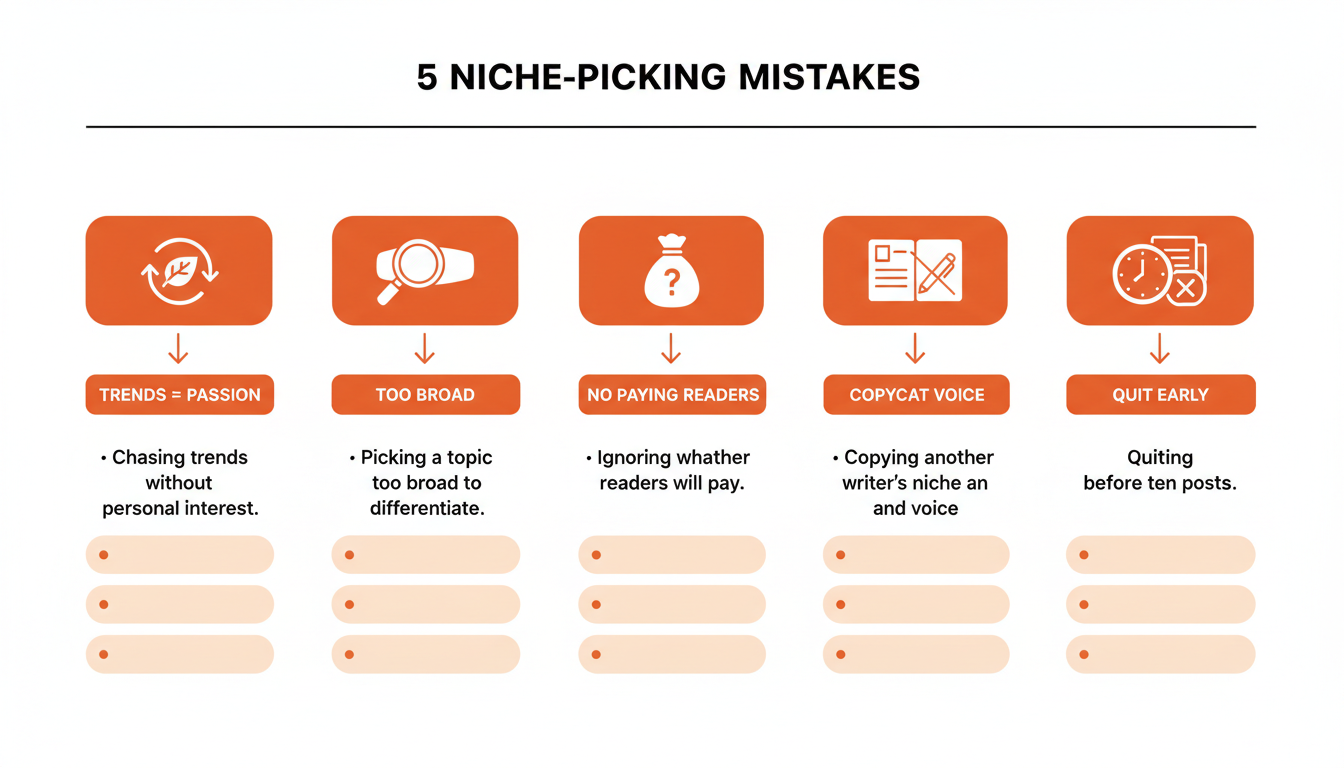
The writers who end up starting over almost always fall into one of these patterns.
Chasing whatever's trending instead of what they know. Jumping into AI content because it's the topic of the moment, with no personal experience or lasting interest in it, produces exactly the high-competition, low-differentiation newsletter the data above warns against.
Picking a topic too broad to give readers a reason to choose them specifically. "Personal finance" or "productivity" without a narrower angle competes against thousands of similar newsletters with no way for a new reader to tell them apart.
Ignoring whether the audience has any history of paying for content in that space. A niche with no track record of anyone monetizing anything similar is a hobby project until proven otherwise, which is fine, but worth knowing going in.
Copying another writer's niche and voice instead of finding their own angle. Readers can tell when a newsletter is a copy of a more established one, and it rarely out-competes the original.
Quitting before the first ten posts are even published. Judging a niche after three posts is judging noise, not data.
Deciding the whole thing from memory. This is the quiet one, and it undoes the other five, because a writer who can't see which angle outperformed will re-pick the niche they were already attached to and call it evidence.
Six weeks in, you stopped guessing which niche was working. You know the angle that pulled 40 people into your archive, you know your restack rate is running above the field for a publication your size, and you know which candidate the readers kept coming back for. The list you were staring at in week one is gone, and a record replaced it. WriteStack is the layer that holds it: the queue that runs the test, the live feed that shows the niche as it is this week, and the benchmarks that say whether your answer is any good. Close to 100 verified reviews from Substack writers back that up, and no competing tool has any we could find.
Start your free 7-day trial. Put four niche angles in the queue tonight. Know which one works by the end of the month.